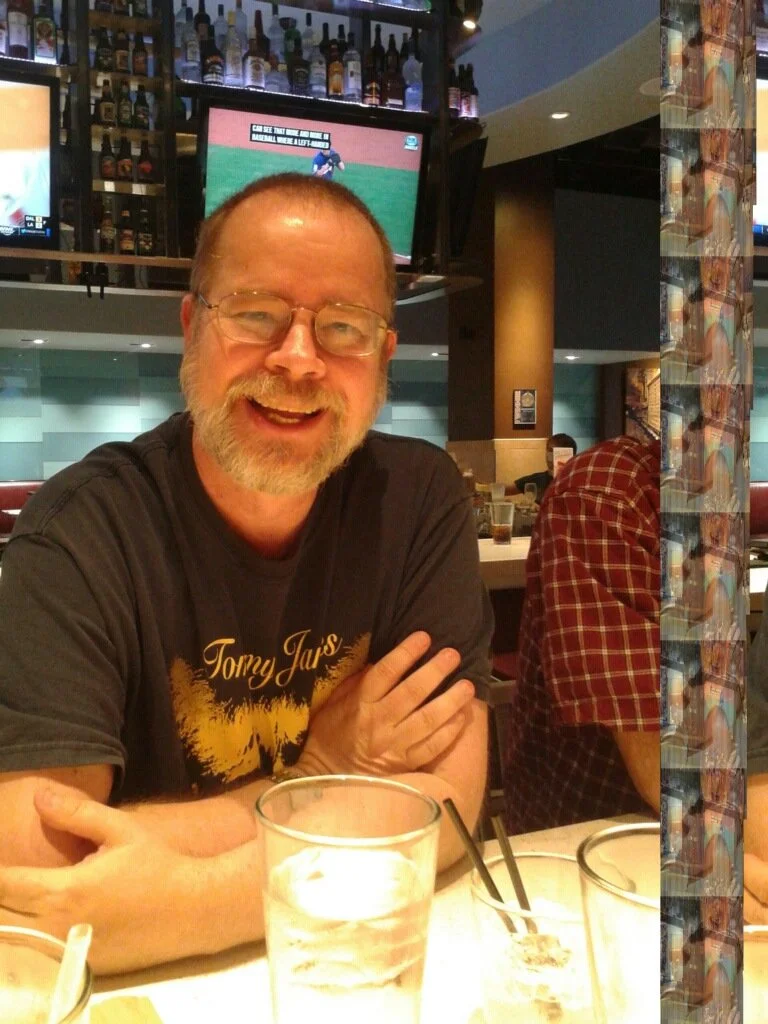
I started writing poems, or what seemed to be poems, at fifteen. They ended up more like song lyrics since I had my transistor radio continuously glued to my ear. I soon wearied of writing with endless choruses and rhymes. I didn’t have much in terms of subject matter: I was more influenced by Tommy James and the Shondells than William Carlos Williams, at least then.
Those were fun writing days. I was like a dog running wherever I wanted. And I wanted to get under the ice, to see what I hadn’t seen before, to unearth a bit of leaf that got caught by the ice. I don’t think I’m much different now, over fifty years later. I never know what’s under the ice, but I like to see what may (or may not) be there. A beautiful illusion may appear—or a monster.
Ice holds surprise. I love a cold Wisconsin lake in winter, Little Lake St. Germain, the surface frozen over, walking on ice to get to the road. Each step elicits a small crackle, as if the ice could talk. I listen closely. Perhaps the water lilies, superb in their yellow July shirts, speak now in their submerged world. Or fish. What do the perch have to say to each other? A poet listens and interprets.
Ice holds danger. Even in a cold winter, softer spots appear. I’d be in trouble if the ice broke and water took me over. Risk is never far away. When I write, I know that my poems may not please all readers. Once a poem gets out into the world, it can be seen as offensive, even when offense isn’t intended. But sometimes it is intended. If the house is on fire, someone should try and get everyone up. Sleep can be deep. Will the words get through?
Sometimes I’ve felt like I lived under ice—language taken from me, the truth of my own life unwelcome—yet it feels good to break the ice, come up for air, and speak. I’m gay and for years I stayed under the ice thinking it would protect me, that silence was an ice castle, impregnable. I sat in that castle, feeling alone, not realizing others were in similar castles until they stepped free of them—took a risk, took many risks. In my mid-twenties I stepped out of my own ice castle. I started to write without the muzzle, without ice sealing my lips.
It felt good to speak—and still does. Poetry challenges you to think critically about how to speak. Even when we feel ready, finding the best language and tone can be a struggle. I enjoy working in various forms, though it can be hard to choose the form that fits what I want to say. Sometimes I think of poetry as a shoe store. I enter it without knowing what I’m looking for. I have to try on many shoes before I find a good fit with a pleasing design. Or maybe the poem wants to be barefoot, tiptoeing between tulips and glass.
Two features of my poem “Under Ice” stand out: lineation and word choice. The poem didn’t begin as three tercets, but as I chipped away at what was unnecessary or unhelpful, the focus strengthened and the tercets sharpened it. I often work in tercets; a clean and precise quality emerges in that form. With word choice, tension grows between “immovable” in the first tercet and “undeterred” in the last tercet. The poem feels more optimistic as spring will come even if it feels distant. The ice will melt and flowers will return. The undeterred survives and thrives over the immovable.
A return to the lake: When the ice is sturdy, fishermen and fisherwomen go out and cut holes in the ice to fish. It’s cold in their large parkas, but they go out, determined to find what moves under the ice. This is what poets do. And while I am not looking for what they seek, we both know that something of value lives under ice. They often have to wait to find it. Just dropping a line may not be enough. The wait can be boring or it can create great anticipation. Poetry does the same. A word, a sound, a line break: each takes time to find. Just when I think I have something right, I find it was only a nibble. I have to keep searching. I enjoy the search—even if sometimes I start pulling my hair out. I may not catch anything, but each time I go out on the ice, I’m closer to getting it. Revision takes me closer too. And patience, lots of patience.