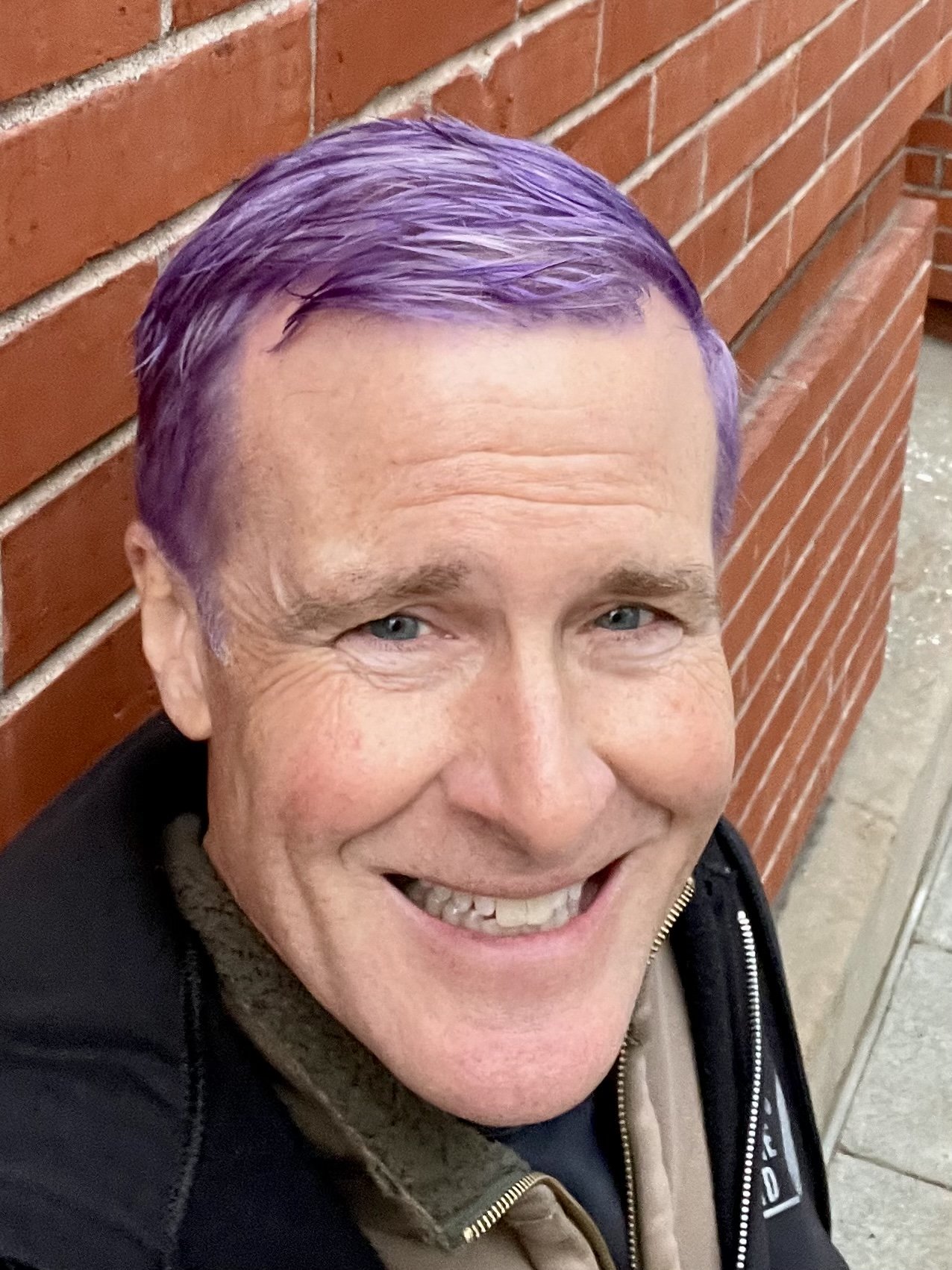
I dyed my hair lilac when I quit my job. It wasn’t so much that I thought that would be a good look for me, I just wanted to check the mirror and see “poetry hair” instead of “litigation hair.”
For 32 years, I litigated. And, for the most part, I loved it, especially my 29 years as a legal aid lawyer in Oregon representing people who couldn’t afford to pay for a lawyer. Still, enough is enough of anything. For as long as I can remember, I have read and written poetry. A not uncommon day for those 32 years was 10 minutes of writing poetry followed by 10 hours of litigation. That may keep your poetry brain alive, but it doesn’t keep it happy.
This year has been different. I left my job as the Director of Litigation at the Oregon Law Center in January and moved to a log cabin in the North Cascades near the Canadian border (just in case). I have had way more time to read, write, revise, and send my poems to market, and I’ve been lucky enough to have some accepted for publication, including by Abraxas Review. I’ve also had the time to slowly work my way back through 32 years of handwritten poetry journals, saving what I can and smiling at all the weird failures.
Sending poetry into the world is scary. As a lawyer, I helped my clients tell their stories. That often had its challenges, but my poems are my stories or at least necklaces of words of my own making. There are fewer places to hide. This change has been transformative. I have had to consider things about my poetry that my consuming day job allowed me to avoid. Things like: Why am I writing these strange words every day? Is my poetry good enough to share with the world? What, if anything, do I really want to say?
I have not answered any of those questions, but having more time to seriously ask them has been a gift. Poetry stands alone and apart, for me, because of the way poems marry meaning to music. There is the sound of words and there is the meaning of those words. Of course, this fuzzy binary cannot be unmixed or measured, but there are certainly poets that I admire all along the double-helix spectrum of meaning and music. I read Claudia Rankine primarily because of what she shows me about the world. I read John Ashbery primarily because of the hilarious way he strings words together. Great poets, including those two, both have something to say and a surprising, beautiful way of saying it. The poets that I return to—Danez Smith, Crystal Williams, Jorie Graham, Galway Kinnell, CA Conrad, Franny Choi—are impossible to place within my make-believe dichotomy, because they just float along the spectrum, marrying meaning to music, in varying and unexpected ways. That, to me, is poetry.
I, too, want to dance along that thread, and I try to do that every day when I caffeinate, open my journal, and let my pen hover above the endless possibility of empty paper. In general, I find the musical wilderness of sound to be a more comfortable place to inhabit than the “say the thing you mean to say” city of clear meaning. I’m not sure why that is, but I think it goes back to having a place to hide. Despite 32 years of litigation, I am not someone who relishes conflict. I grew up in Indiana in a family that placed a high value on privacy, politeness, and not offending others. Small talk was our lingua franca. And some of my relatives were and are really good at it. There are beautiful ways to beat around the bush.
And yet, some things need to be said without obfuscation. Maybe poetry is not the most obvious vehicle for that, but it is certainly a vehicle. I learned as a legal aid lawyer that low-income or no-income folks in this country are not only blamed for their own poverty, they are often vilified. Low-wage workers are blamed for staffing shortages. Homeless people are blamed for homelessness. On and on and on. But who wants to read a poem that reads like an angry social media post or an unhinged, all-caps rant? Not me (most days). I want poetry that tickles my brain and makes me think of things that aren’t squarely on the page.
When I read Jorie Graham, for example, I may be vaguely aware that she is, on some level, “writing about” climate change, but what I am thinking is often a combination of surprising thoughts that I can’t consciously unpack with any exactitude. The short version of this experience is: holy shit! The longer version is some lingual volcano involving: the state of the physical world, the state of the metaphysical world, the state of our souls, the complexity of her diction, the beauty of the stacked images and phrasing that leave you feeling a little dizzy, desperate for a period, a comma, or even a question mark. By the end, she hasn’t written an essay about saving the planet, but she has created something so breathtaking that it makes me feel like the planet is worth saving because it provided a habitat for her poetry.
Obviously, that is a high bar to set as aspiration. Maybe impossible. But you never really know your limitations until you bang your head against them. I believe that words—and what they have the power to convey—can be funny, mysterious and serious all at the same time. That has been my experience outside of poetry, so why not inside of it too? Also, I believe that you can say the thing you mean to say in infinitely different ways and the fact that a poem isn’t saranwrap clear to every reader in precisely the same way doesn’t mean that it has nothing to say.