Noticing What I Notice: A Craft Essay by A. Fetters
My kids jostle for position around a copy of Winslow Homer’s Snap the Whip, an 1872 painting of children playing a schoolyard game. Ready, set, go. A timer counts one minute; my kids’ eyes scan the image, hungry for every detail. They squirm and elbow each other, but remain silent; they’ve made this game into a competition, each child determined to outdo their siblings.
The timer buzzes. I turn the picture facedown. My kids take turns answering the simple, alchemical questions I learned from a mentor: What did you see? What did you notice?
They list the obvious things first. There are eight children in the painting, all boys. They’re playing Snap the Whip. The weather is nice.
With the broad gist of the painting established, they fill in the mid-level details from their memories: there’s a red building in the background, maybe a one-room schoolhouse. The boys are all barefooted. One boy is falling. There’s a lot of grass. They look like they’re having fun. Can we play that game, Mom?
Once they run out of details to share, I set the timer for another thirty seconds and display the picture again. This time, with all the obvious things out of the way, they turn their attention to smaller items previously overlooked: a church steeple in the background. A feather in one boy’s hat. Miniature adults standing in the far distance. Curtains waving in the breeze of an open window. Slim, reflective pockets of water—a creek, perhaps—beyond the schoolhouse.
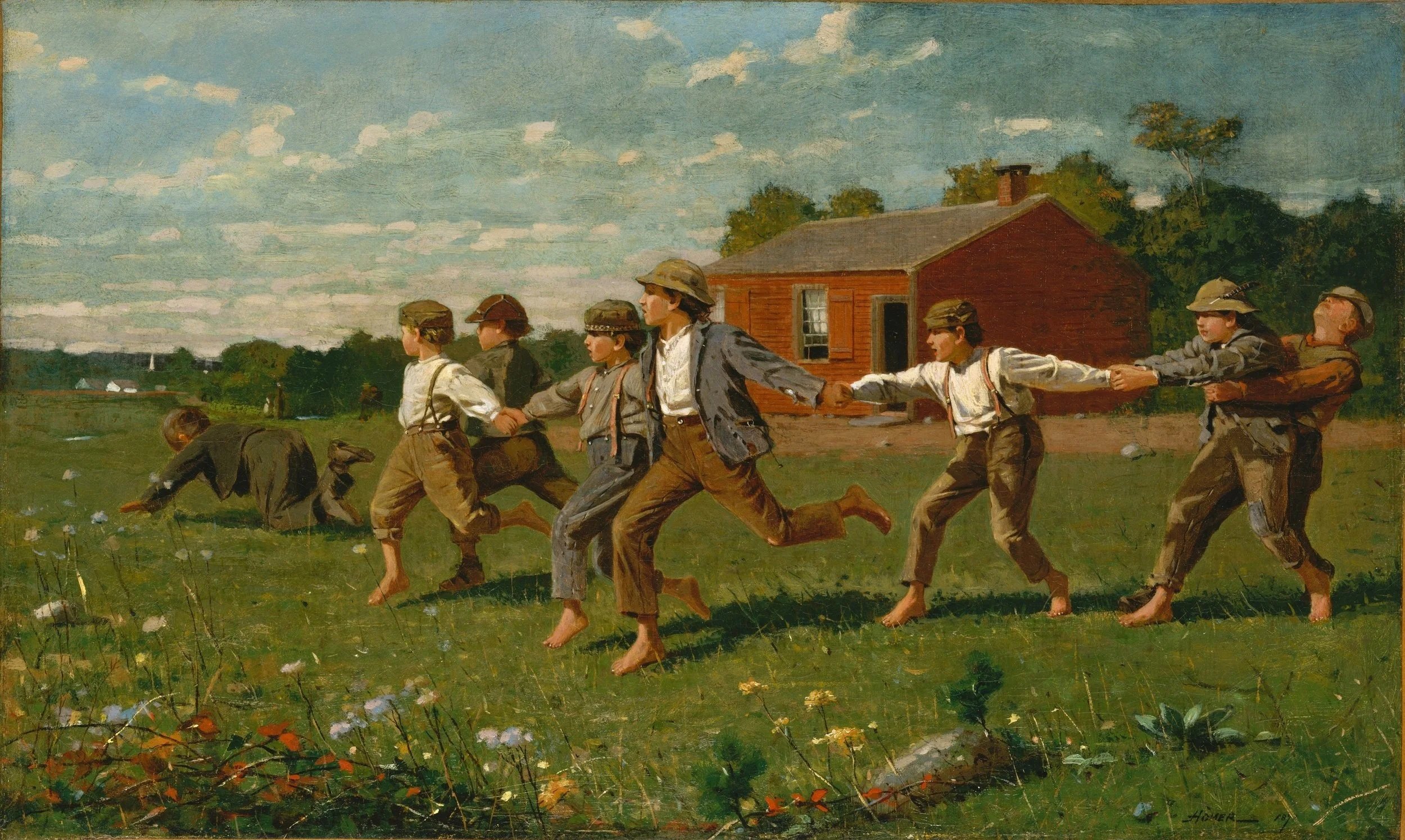
They surprise me with the things they notice; I hadn’t seen many of them for myself. My second-born, seven years old, wins the contest. After everyone else’s memories are exhausted, she lifts her chin and crows her winning observation: there are wildflowers in the foreground.
Our Winslow Homer study happened roughly a decade ago during a period when our family was homeschooling and deep into all things Charlotte Mason, but I thought of it recently as I paged through my copywork notebook. I’ve only recently taken up the practice—an echo of those long-ago questions: What did you see? What did you notice?
The way it works is this: when I read something lovely—or surprising, or funny—I copy it into my notebook, taking my time, making sure to get every word just right. Using a nice pen helps (I’m a Uni-Ball 207 Plus+ kind of person). Below the copied passage, I write a list of all the things I notice about the writer’s craft: sentence structures, verb choices, grammatical rules observed and broken. I’m trying to uncover the writer’s secrets, their micro-moves, their sleight of hand: how did they do it? I return to the passage again and again until I run out of things to notice.
Sometimes the writing is so good that it’s hard to stay focused on how the writer does what they’re doing. Instead, I get lost in the gorgeous halls they’ve built with their words—like the way Samantha Harvey can weave a sentence that’s two pages long and you don’t even notice its length until you hit a period that feels like a gut punch. Or how Robin Sloan uses so many words that I have to look up (attenuated, diaphanous, mendicant, penumbra, stochastic) that turn out to be precisely the right words—but he will also describe a complex civilization’s disastrous collapse as “a bummer” (also precisely the right words). Or the way reading Joanne Harris sometimes feels like the verbal equivalent of consuming tiny, rare delicacies: an undersea queen with a coral throne and a gown of “gilded sea-foam” who swims “in a midnight darkness shot like phosphorescent silk.”
I’ve always been a fast reader, apt to gulp pages whole. But engaging in this practice of copywork—with a gaze like my children’s, eagerly soaking up every brushstroke—forces me to slow down. Lets me sink my teeth in, feel the textures, chew on the metaphors. Analyze the craft, peel back its inner workings, fiddle with the gears. And the next time I sit down with my own writing, I have something new to test-drive.
I like to think that copywork will make me a better writer—or maybe just a better noticer. Not all at once, perhaps, but with the slow drip of a memory crammed with good things, hunting for minutiae, finding what I overlooked before, entranced with the seeing, enamored with the noticing.